The Best Joint Supplements for Cats to Support Mobility
The most effective joint supplements for our cats usually pack a powerful punch with a combination of well-studied ingredients. Key players like glucosamine, chondroitin, and omega-3 fatty acids work together to protect cartilage and soothe inflammation. Think of them as a team dedicated to keeping joints lubricated, supporting cartilage repair, and easing pain, all of which are critical for your cat's mobility and happiness.
Why Your Cat Might Be Hiding Joint Pain
Have you noticed your cat thinking twice before making that big leap to the windowsill? Maybe they've been a little grumpier than usual? These small shifts are often the first quiet clues of joint pain, a problem cats are hardwired to hide.
This is a deep-seated survival instinct. Out in the wild, any sign of vulnerability—like stiffness or a limp—paints a target on a cat's back for predators. Our house cats carry that same instinct. They are masters of hiding their pain, so much so that even the most dedicated owners can easily miss the early signs. This is exactly why being a proactive observer is so important for their health.
Recognizing the Silent Signs
Since our cats can't just tell us what's wrong, we have to put on our detective hats. We're looking for subtle changes in their behavior and daily habits, not a dramatic limp or a yelp of pain. The clues are usually much quieter.
Here are a few key behavioral shifts to watch for:
- Hesitation Before Jumping: You might notice the cat who used to fly onto the counter now stops, measures the distance, and sometimes gives up on the idea altogether.
- Reduced Grooming: A stiff, sore body makes it tough to twist and groom properly. This often results in a scruffy or matted coat, especially over the lower back and hips.
- Changes in Temperament: Your sweet, cuddly friend might suddenly hiss or lash out when you try to pet them, particularly if you touch a sore spot like their hips.
- Avoiding the Litter Box: If getting into a litter box with high sides becomes a painful ordeal, your cat might start doing their business in more accessible—and less appropriate—places.
It helps to think of your cat's cartilage as the shock absorbers in a car. After years of jumping, playing, and exploring, those cushions just naturally wear down. It's a slow process that often flies under the radar until the damage is bad enough to cause real, visible discomfort. While decoding these signs can be tough, learning about natural methods for alleviating joint pain can give you a good foundation for helping your cat feel better.
Picking up on these quiet signals is your first and most important move. When you understand that a change in behavior is often a red flag for physical discomfort, you can step in early to support their joint health before a little stiffness turns into a major mobility problem.
Decoding Core Ingredients for Joint Repair
When you start scanning the labels of cat joint supplements, a few key ingredients show up again and again. These aren't just there for show; they're the fundamental building blocks that help support, repair, and protect your cat’s joints. Getting to know what they do is the first step toward picking the right product with confidence.
Think of your cat’s joint cartilage like a well-built brick wall. To keep that wall strong and stable over the years, you need the right materials for construction and ongoing maintenance. The best supplements are the ones that supply these exact materials.
H3: Glucosamine: The Cartilage Builder
The first and most famous ingredient you'll see is glucosamine. This is a naturally occurring compound that’s a non-negotiable component of cartilage—that tough, flexible tissue cushioning the ends of bones within a joint.
Imagine glucosamine as the "bricks" for that cartilage wall. It provides the essential raw materials your cat's body needs to build new cartilage and patch up existing damage. As cats get older, their natural ability to produce glucosamine slows down, leaving their joints more vulnerable to the daily grind of jumping, climbing, and pouncing. Supplementing with glucosamine essentially restocks this vital supply, shoring up the structural integrity of their joints.
H3: Chondroitin: The Moisture Magnet
Working hand-in-hand with glucosamine is chondroitin sulfate. If glucosamine provides the bricks for the cartilage wall, you can think of chondroitin as the "mortar" that holds it all together and, just as importantly, keeps it hydrated.
Chondroitin’s main job is to act like a sponge, attracting and holding water within the cartilage. This is absolutely crucial. Well-hydrated cartilage is springy, elastic, and fantastic at absorbing shock. But that's not all it does. Chondroitin also helps block certain enzymes that are notorious for breaking down cartilage. This one-two punch not only maintains the joint’s cushion but actively defends it from further wear and tear.
H3: MSM: The Soothing Supporter
The final player in this powerful trio is MSM (Methylsulfonylmethane). While glucosamine and chondroitin are busy with the structural work, MSM steps in to provide comfort by helping to manage the body's natural inflammatory response.
MSM is a fantastic source of sulfur, a mineral that’s essential for forming connective tissues like cartilage and ligaments. Its real claim to fame, though, is its ability to help soothe the soreness and stiffness that come with an active life. By supporting a healthy inflammatory response, MSM helps ease discomfort, which in turn allows your cat to move more freely and comfortably.
To give you a quick reference, here’s a simple table breaking down what these powerhouse ingredients do.
Key Ingredients in Feline Joint Supplements at a Glance
| Ingredient | Primary Function in Joints | Analogy for Understanding |
|---|---|---|
| Glucosamine | Provides the building blocks to create and repair cartilage. | The "bricks" for the joint's cartilage wall. |
| Chondroitin | Attracts and holds water for shock absorption and blocks destructive enzymes. | The "mortar" and "waterproofing" for the wall. |
| MSM | Helps manage a healthy inflammatory response to ease discomfort and stiffness. | The "maintenance crew" that soothes and repairs. |
As you can see, these ingredients don’t work in isolation—they create a powerful synergistic effect. Glucosamine builds, chondroitin protects and lubricates, and MSM soothes. This team approach addresses feline joint health from every angle, creating a solid foundation for any high-quality supplement.
The need for this kind of support is clear. The global market for pet joint health supplements was valued at about USD 2.10 billion in 2025 and is projected to skyrocket to USD 3.76 billion by 2035. Cat owners are a huge part of this growth, showing just how vital these ingredients have become.
Cats are masters at hiding pain, but subtle changes in their behavior can be a dead giveaway. The infographic below highlights some of those signs, like hesitating before a jump or suddenly becoming grumpy.
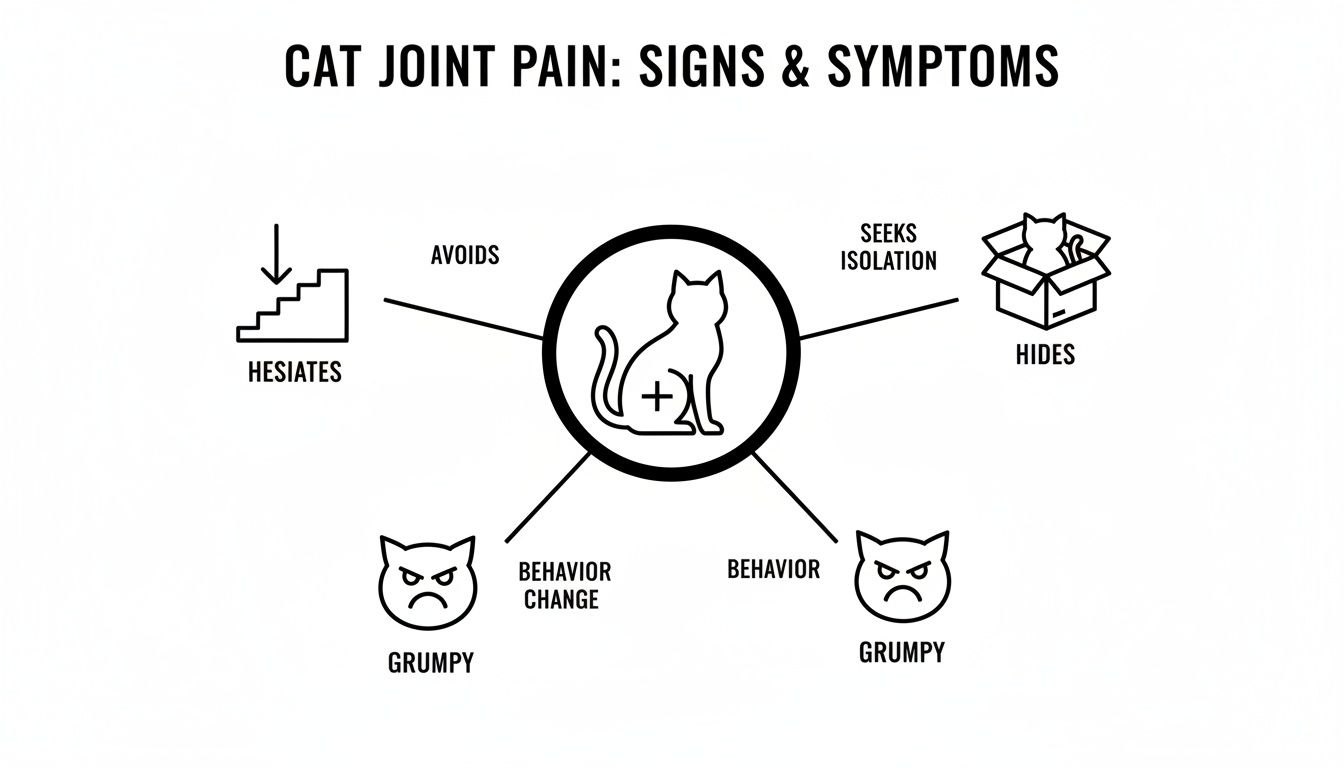
This illustrates that discomfort isn't always about limping; it often shows up as behavioral shifts, which is why proactive support is so important.
It's also worth noting that many of these ingredients contribute to overall wellness. For instance, understanding the comprehensive benefits of multi collagen peptides shows how some compounds can support not just joints but also skin and coat health.
While a targeted joint supplement is fantastic, it works best as part of a complete nutritional strategy. For a wider view on feline health, you might find our guide on the best vitamins for cats a helpful companion piece. By understanding these core components, you’re now much better equipped to read a label and choose the perfect joint supplement for your feline friend.
Quelling the Fire: The Role of Anti-Inflammatories
While ingredients like glucosamine and chondroitin are the "brick and mortar" for joint repair, you can't rebuild a house while it's still on fire. Chronic joint inflammation is a lot like a slow, smoldering fire inside the joint capsule—it generates constant heat, pain, and further tissue damage. This destructive environment makes it nearly impossible for any real healing to happen.
To give your cat meaningful relief, you have to put out that fire. That’s where anti-inflammatory ingredients come in. Think of them as the firefighters of joint health; they cool the inflammation, ease the pain, and create a healthy, stable environment where the body's repair crews can finally get to work.
Omega-3s: The Joint Firefighters
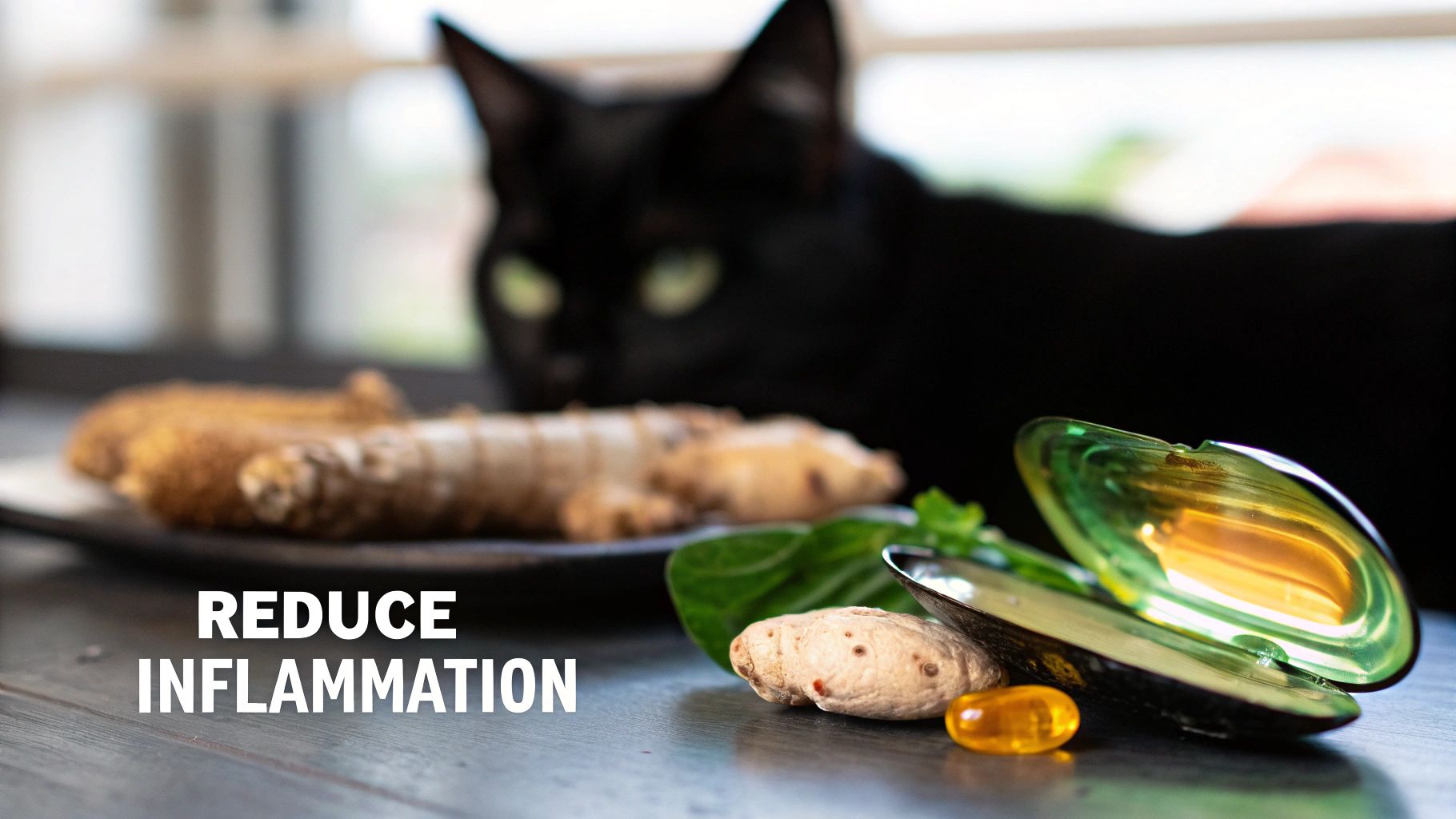
The most powerful and scientifically backed anti-inflammatories for joint health are the omega-3 fatty acids, specifically EPA (eicosapentaenoic acid) and DHA (docosahexaenoic acid). These aren't just trendy additives; they are essential fats that directly influence the body's inflammatory response.
When a joint is irritated, the body produces inflammatory compounds that perpetuate the pain cycle. Omega-3s work by getting the body to produce different, anti-inflammatory compounds instead. This shift effectively turns down the dial on joint discomfort, dousing that internal fire and bringing significant relief from stiffness and pain. Frankly, any top-tier joint supplement for cats should include them.
The best sources of EPA and DHA for our feline friends are:
- Fish Oil: A classic for a reason. Oils from cold-water fish like salmon, sardines, and anchovies provide a potent, concentrated dose of omega-3s.
- Green-Lipped Mussel (GLM): This unique shellfish from New Zealand is a true powerhouse. It's naturally loaded with omega-3s and also happens to contain glucosamine and chondroitin, offering multiple benefits in one ingredient.
Omega-3s aren't just a helpful "extra"—they are a cornerstone of modern joint support. They get to the very root of the problem by targeting the inflammatory pathways that cause pain, making them absolutely essential for improving your cat's comfort and quality of life.
The science and market data back this up. The pet supplement industry is booming, projected to grow from USD 2.71 billion in 2025 to USD 4.11 billion by 2030. A huge driver of this growth, especially in the rapidly expanding cat segment, is the widespread recognition of ingredients like omega-3s for joint support, as noted in reports from MarketsandMarkets.com.
Botanical Allies for Soothing Joints
Beyond the powerful fats from the sea, certain plants offer remarkable anti-inflammatory benefits that can lend an extra hand. These botanicals often work through different mechanisms than omega-3s, allowing you to tackle inflammation from multiple angles for a more profound effect.
Two of the most effective and well-researched botanicals are turmeric and Boswellia serrata.
Turmeric and Curcumin
We all know turmeric as the bright yellow spice in curry, but its real power comes from its active compound, curcumin. Curcumin is a potent antioxidant and anti-inflammatory that helps neutralize destructive free radicals and block certain enzymes that fuel inflammation.
One catch: curcumin isn't easily absorbed on its own. When choosing a supplement, look for one formulated for high bioavailability. Quality products will often pair it with something like black pepper extract (piperine) or use a specific formulation to ensure your cat’s body can actually use it.
Boswellia Serrata
Also known as Indian frankincense, Boswellia serrata is a resin from the Boswellia tree. It contains active compounds called boswellic acids, which have a knack for targeting inflammation specifically within the joints.
What makes Boswellia so compelling is that it helps soothe joints without the harsh digestive side effects that can come with some traditional pain medications. It supports comfortable movement and helps maintain the joint's structural integrity, making it a fantastic partner for other ingredients. Our guide on the best omega-3 for cats digs deeper into how these fatty acids can complement other supplements.
By combining foundational builders like glucosamine with powerhouse anti-inflammatories like omega-3s and select botanicals, you create a truly comprehensive support system. This strategy does more than just patch up existing damage—it actively soothes discomfort and calms the underlying inflammation, giving your cat the best possible chance to move freely and feel like themselves again.
A Look at More Advanced Formulations
While glucosamine, chondroitin, and MSM are the heavy hitters we’ve relied on for years, the science behind feline joint care keeps moving forward. The best modern supplements often include a new wave of ingredients that offer more specialized support, zeroing in on things like joint lubrication and a more holistic approach to repair.
These additions don't replace the core ingredients; they fine-tune the formula, tackling joint comfort from different angles. Let's dig into a couple of the most promising ones.
Hyaluronic Acid: The Joint's Natural Lubricant
Think of your cat's joints as a well-oiled machine. Hyaluronic Acid (HA) is the oil. It’s the main ingredient in synovial fluid—the slick, viscous liquid that fills the joint capsule and lets the bones glide past each other without friction.
But as cats get older or arthritis sets in, the body produces less of this crucial lubricant. The "motor oil" gets thin, and that’s when friction starts causing inflammation, pain, and more damage to the cartilage. Adding HA back into the mix helps replenish this fluid, keeping the joint cushioned, lubricated, and moving smoothly.
By directly supporting joint lubrication, Hyaluronic Acid does more than just soothe discomfort—it helps preserve the joint itself. A well-lubricated joint experiences less friction, which means less wear and tear on that precious cartilage over time.
Smart Ingredients from Natural Sources
Beyond the individual compounds, some of the most effective ingredients today come from whole-food sources that naturally pack a punch. They offer a built-in blend of nutrients that work together, often more effectively than their isolated parts.
A fantastic example is eggshell membrane. It’s that thin, delicate layer you see inside an eggshell, and it happens to be a treasure trove for joint health. It naturally contains:
- Collagen: The primary protein that gives cartilage its strength and structure.
- Elastin: A protein that helps tissues stay flexible and snap back into shape.
- Hyaluronic Acid: For that all-important lubrication.
- Glucosamine and Chondroitin: The building blocks for cartilage repair.
Because all these components are present in their natural matrix, they tend to be highly bioavailable, meaning your cat's body can absorb and put them to use right away. It's a powerful, all-in-one ingredient that you’ll find in many top-tier formulas.
The Make-or-Break Factor: Will Your Cat Actually Eat It?
Let's be honest: even the most scientifically advanced joint supplement is completely worthless if your cat turns her nose up at it. Feline pickiness is the stuff of legend, which is why the format of the supplement is just as critical as the formula inside.
This is a big deal for manufacturers, too. The market for pet supplements is growing fast—projected to jump from USD 3.14 billion in 2025 to USD 4.82 billion by 2032. A huge driver of that growth is owners looking for products that are not only effective but also easy to give. You can read more about these trends in this pet supplement industry report.
So, what are your options?
| Format | The Good | The Bad |
|---|---|---|
| Soft Chews | Highly palatable and often flavored like treats. Dosing is super simple. | Can have extra fillers or calories. Some cats are picky about the texture. |
| Liquids | Easy to mix into wet food for quick absorption. | The smell or taste can be a dealbreaker. Can be messy to measure. |
| Powders | Usually a concentrated formula that mixes easily into food. | A discerning cat will detect it and go on a hunger strike. Can be dusty. |
At the end of the day, the best format is the one your cat will take every single day without a fight. When it comes to joint supplements, consistency is everything. Finding an option your cat finds palatable is the first, and most important, step to getting them the relief they need.
How to Choose a Safe and Effective Supplement
Walking down the pet supplement aisle can feel like a pop quiz you didn't study for. Every bottle makes a bold promise, but how can you tell which ones are genuinely helpful and which are just clever marketing? The trick is to learn how to read a label like a pro and know what really signals quality and safety for your cat.
This isn't about hunting for some miracle cure in a bottle. It's about making a smart, informed choice by looking for specific clues that show a company is serious about quality, not just sales.
Decoding the Supplement Label
Forget the flashy claims on the front of the packaging for a moment. The real story is always on the back. A truly high-quality supplement gives you clear, specific information that puts you in the driver's seat.
Here’s what you need to zero in on:
- Guaranteed Analysis: This is non-negotiable. It must list the exact amount of each active ingredient (glucosamine, chondroitin, etc.) per chew or per ml. If you see vague terms like "proprietary blend" without specific quantities, that's a huge red flag. It’s a way for companies to hide how much—or how little—of the important stuff is actually inside.
- Active vs. Inactive Ingredients: The label should draw a clear line between the "active" ingredients doing the heavy lifting and the "inactive" ones used for taste, texture, or preservation. Take a hard look at that inactive list. You want to see minimal, high-quality ingredients, not a long list of unnecessary fillers, sugars, or artificial additives.
- Clear Dosing Instructions: A reputable company has done its homework. Look for precise, weight-based dosing instructions, which often include a higher "loading dose" for the first few weeks. Vague directions suggest a lack of research.
The Gold Standard of Quality Assurance
The pet supplement world isn't regulated as strictly as veterinary drugs, which makes voluntary certifications incredibly important. These are your best indication that a company is holding itself to a higher standard.
The most crucial clue to look for is the National Animal Supplement Council (NASC) Quality Seal. This little seal means the manufacturer has passed a rigorous, independent audit of its entire operation—from sourcing raw materials to final labeling. It’s third-party proof that what’s on the label is what's in the bottle.
Finding that NASC seal gives you an enormous amount of confidence. It’s an independent stamp of approval that tells you the product is made with care and integrity.
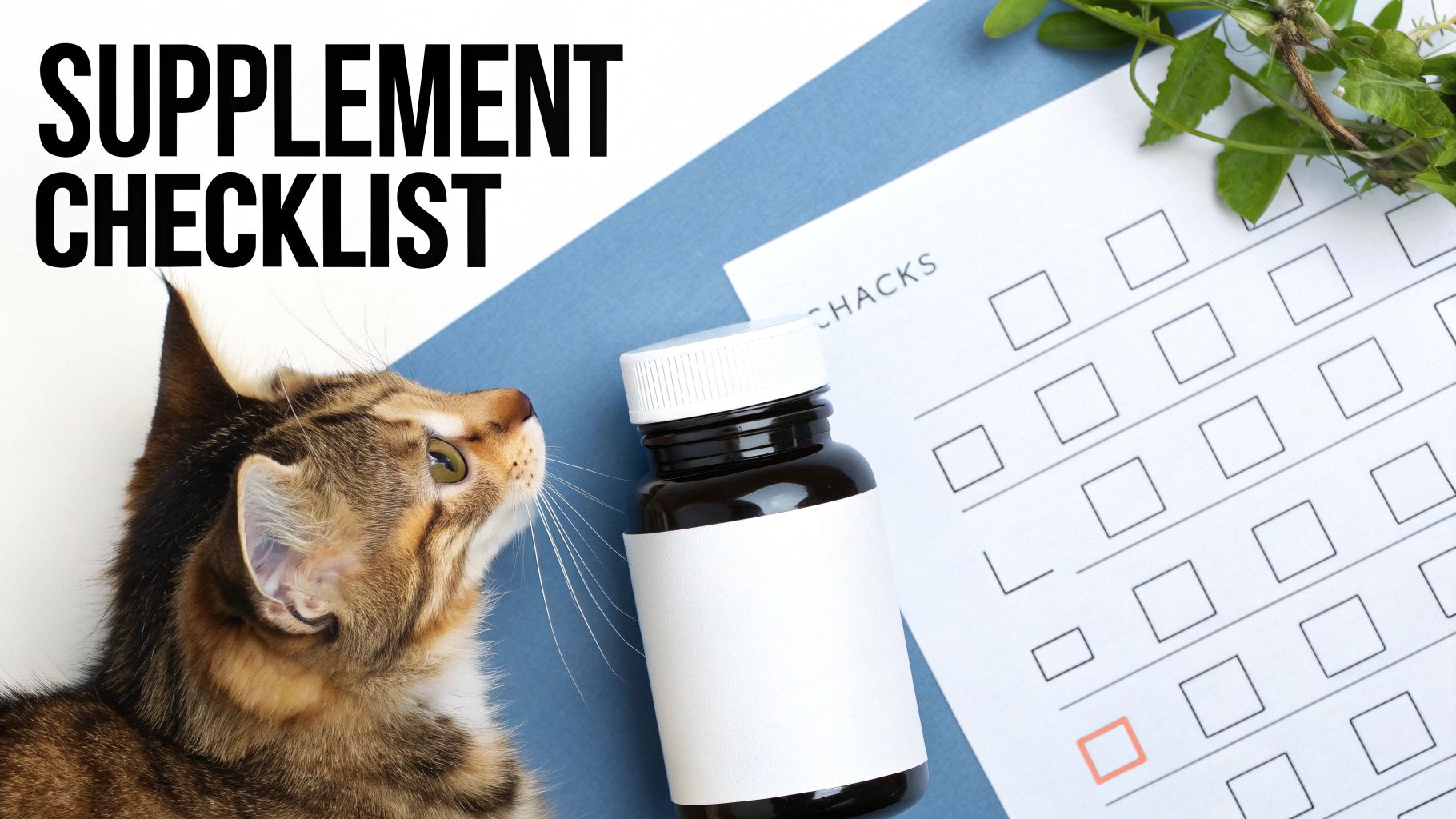
To help you put all this information to use, here's a quick checklist you can use when comparing products.
Supplement Quality Checklist
Use this checklist to evaluate the quality and safety of a potential joint supplement for your cat.
| Quality Check | What to Look For | Why It Matters |
|---|---|---|
| NASC Quality Seal | The seal is clearly visible on the packaging. | This is the highest standard of independent quality control in the industry. |
| Guaranteed Analysis | Specific amounts (mg) for all active ingredients. | Ensures you know the exact dose your cat is getting and prevents underdosing. |
| Clear Dosing | Instructions are based on your cat's weight. | Proper dosing is critical for both safety and effectiveness. |
| No "Proprietary Blends" | The formula is transparent, not hidden behind vague terms. | Transparency shows the company has confidence in its formula. |
| Feline-Specific Formula | The product is made specifically for cats. | Avoids potentially toxic ingredients (like xylitol) and incorrect dosages found in human or dog products. |
| Contact Information | The manufacturer provides a phone number, email, or address. | A reputable company stands behind its product and is available to answer questions. |
This quick scan can immediately help you weed out the lower-quality options and focus on the ones that are truly worth considering for your cat.
Red Flags to Watch Out For
Just as important as knowing what to look for is knowing what to avoid. Some things should make you put the bottle right back on the shelf.
Steer clear of any products with:
- Unrealistic Claims: Be skeptical of anything that promises to "cure" arthritis or deliver "instant" relief. Supplements are meant to support long-term joint health, not act like a magic pill.
- Human Formulations: Never give your cat a supplement made for people or even dogs. The dosing will be wrong, and some common inactive ingredients in human products, like the sweetener xylitol, are extremely toxic to cats.
- No Contact Information: If you can't easily find a company's phone number or email address, that’s a bad sign. Trustworthy brands are accessible and transparent.
Choosing the right supplement is just one part of a complete wellness plan for your cat. For a wider view on supporting your cat's health, check out our guide to the best supplements for cats. Armed with this knowledge, you can feel confident you're making a safe and beneficial choice for your best friend.
Partnering with Your Vet for Joint Health
Picking out a joint supplement for your cat feels like a big decision, and it is—but it’s not one you should ever make in a vacuum. Your veterinarian is your most important ally in managing your cat’s joint health and keeping them comfortable and mobile for years to come.
Before you even think about starting a supplement, getting a professional diagnosis is non-negotiable. What might look like simple age-related stiffness could actually be a sign of a completely different health problem.
A thorough exam by your vet can rule out other conditions and confirm that a joint issue is truly what you’re dealing with. This step is critical to make sure you’re solving the right problem from the get-go.
Questions to Ask Your Veterinarian
Once you have a confirmed diagnosis, you and your vet can map out a plan together. It’s a great idea to show up to your appointment prepared with a few questions to make that time as productive as possible.
Here are a few key things to bring up:
- Ingredient Suitability: "Given my cat's specific health history, are there certain ingredients like glucosamine or green-lipped mussel that you'd recommend? Are there any we should stay away from?"
- Correct Dosage: "For a cat of this age and weight, what's the right starting dose? How and when would we know if it needs to be adjusted?"
- Potential Interactions: "My cat is currently taking [list any medications, supplements, or prescription foods]. Are there any potential negative interactions I need to watch out for?"
The best joint supplement for your cat isn’t the one with the flashiest label or the most five-star reviews. It’s the one chosen for your cat’s individual needs, backed by real evidence, and given the green light by your veterinarian.
At the end of the day, your vet’s input is what turns a well-intentioned guess into a truly effective health strategy. This partnership is the safest, most direct path to helping your cat feel their best so they can stay the happy, active companion you know and love.
Answering Your Questions About Cat Joint Supplements
Even after diving into the details, you probably still have a few practical questions about giving your cat a joint supplement. Let's tackle some of the most common ones I hear from cat owners so you can feel confident moving forward.
How Long Until I See a Difference?
When it comes to supplements, patience is key. These aren't like pain medications that offer immediate, noticeable relief. Instead, supplements work slowly and steadily from the inside out, helping to rebuild cartilage and calm inflammation. Think of it as strengthening the joint's foundation—and that takes time.
Most owners start to see small but meaningful improvements within 4 to 8 weeks. You might notice your cat is a little more eager to play, doesn't hesitate as much before hopping onto the couch, or seems more comfortable when grooming. For these ingredients to work their magic, you have to be consistent. If you don't see any changes after about three months, it’s a good idea to chat with your vet about adjusting the dose or trying a different formula.
Are There Any Side Effects to Worry About?
Thankfully, one of the biggest upsides of using a well-made joint supplement is how safe they are. The core ingredients—glucosamine, chondroitin, and omega-3s—are generally very gentle on a cat's system, and side effects are rare.
If you do see a reaction, it's most likely to be a bit of mild digestive upset, like diarrhea, right at the beginning. You can easily sidestep this by introducing the supplement gradually. Just start with a half-dose (or even a quarter-dose) for a few days and slowly work your way up to the full recommended amount over a week.
A quick tip: Look for products with a quality seal from the National Animal Supplement Council (NASC). It’s a good indicator that the brand takes quality control seriously, and the product has been properly tested for purity and safety. It’s a simple way to get some extra peace of mind.
Can I Just Give My Cat a Dog or Human Supplement?
I can't stress this enough: absolutely not. It's incredibly risky to give your cat a joint supplement made for dogs or people. While it might seem like you're saving a trip to the store, the potential consequences just aren't worth it.
Here’s why a cat-specific formula is the only safe choice:
- Toxicity Risk: Many products for humans or dogs contain ingredients that are perfectly safe for them but toxic to cats. The artificial sweetener xylitol is a common one, and it can cause life-threatening illness in felines.
- Incorrect Dosages: The right dose is a careful calculation based on species, weight, and metabolism. What's therapeutic for a 60-pound Labrador could be a dangerous overdose for an 8-pound cat.
- Palatability Problems: Let's be honest, cats are picky. Formulas made for other species often have flavors that cats will flat-out refuse, turning supplement time into a daily struggle you're unlikely to win.
Always, always stick to a product that was formulated, dosed, and tested specifically for cats.
At JoyFull, our mission is to make supporting your pet’s health both simple and safe. Our formulas are made with clean, high-quality ingredients tailored to your cat's specific needs. To help your cat move more comfortably, you can explore our wellness products.